
A Workflow based on DLS for PROTAC induced Complex Validation
Proteolysis targeting chimeras (PROTACs) are considered to be a class of antiviral drugs with significant advantages over classical pharmacology due to its event-driven mode of action and the ability to target any protein of interest's domains (Schwalm et al., 2023). Here, we present a workflow based on dynamic light scattering (DLS) that aims to improve and streamline the evaluation of an PROTAC induced complex formation indicating its linking ability using the WDR5-PROTAC-pVHL ligand quaternary complex as a validation system.
Crystal structure (PDB entry 7Q2J) of the PROTAC induced WDR5-PROTAC-VHL ligand complex quaternary Complex model System
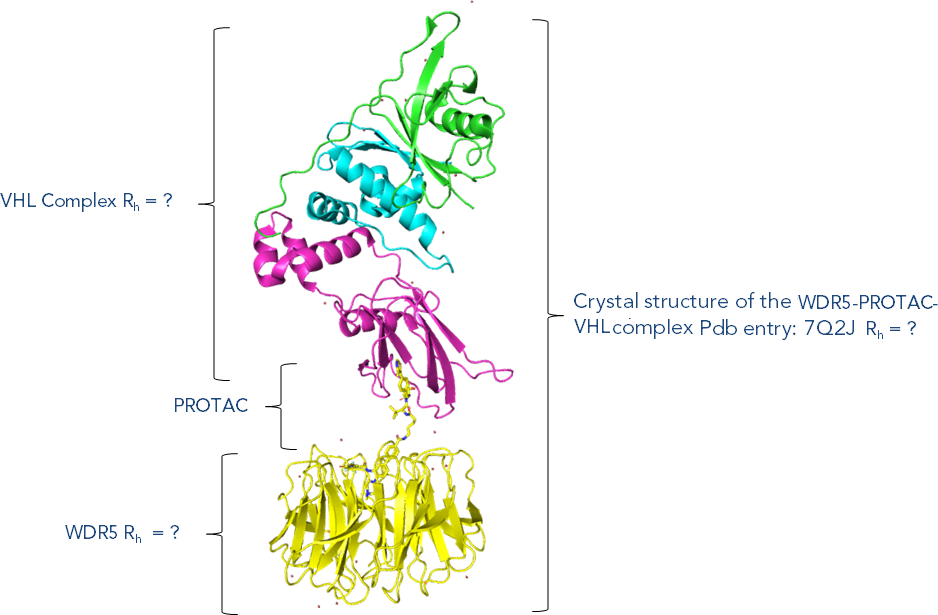
First Step: Two Subunit's absolute Sizes Determination
The pVHL_ElonginC:ElonginB ternary complex (larger subunit) and WDR5 (smaller subunit) were measured separately using the in-plate DLS system SpectroLight 600, resulting hydrodynamic radii (Rh) were plotted together. The Rh differs by as little as seven Angstroms, but in-plate DLS can easily distinguish such small size differences due to its Angstrom level accuracy.
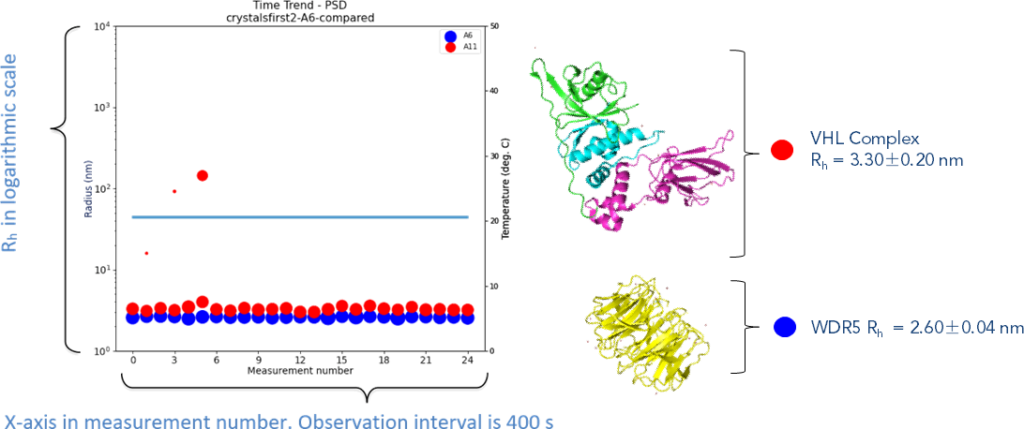
Second Step: Average Size Determination of a 1:1 Molar Ratio Mixture of the Subunits
If the two subunits are not linked by a PROTAC due to its absence, they diffuse independently of each other, when mixed together. The determined size by DLS is the average of the two separately measured sizes (greed dots), which lies in the middle. This average size could later be used to identify PROTAC variants that are unable to induce a ternary complex assembly due to weak or no non-covalent interactions with the subunits.

Third Step: Determination of PROTAC induced Quaternary Complex Assembly by Size Analysis
If a PROTAC variant is capable of inducing a quaternary complex assembly, it can easily be identified using in-plate DLS. Since the subunits are connected they are diffusion together instead of independently as before. The absolute size of this particle fraction exceeds that of the largest subunit of the complex (green dots).

The Efficiency of this Approach requires some Features of SpectroLight 600 in-plate DLS System
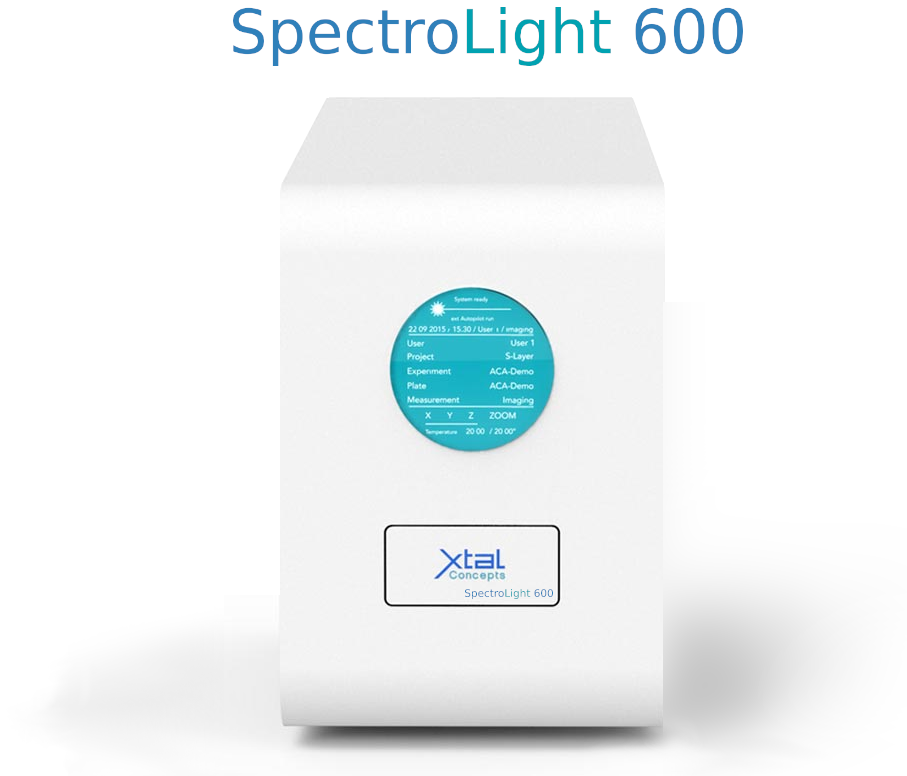
SpectroLight 600's in-plate DLS capability, which can automatically measure in >100 nL droplets, makes this analytical approach highly efficient in terms of both materials and time. With its high accuracy in absolute size determination (error margin of <2%), this is the ideal tool for this type of investigation. Take a look at this highly advanced in-plate DLS system. SpectroLight 600 Product Page
Acknowledgement:
We would like to express our sincere gratitude to our cooperation partner Crystalsfirst for their kind support in the form of samples and advises. This work would not have been possible without their contribution.